The paltry number of women in computer science and engineering, combined with girls’ diminishing interest in science as they age, means parents need to step up to the STEM plate. Here’s how we can help our daughters pursue meaningful and valuable careers—for their sakes and society’s.
By Ellen Lee
It’s hard to be the only girl. For Regine Love’s daughter, Tyler, one of only a few in her computer science class in her freshman year of high school, academics weren’t the problem. Instead, it was having to prove herself again and again to a roomful of boys, either by surprising them with a top test score or speaking up repeatedly to be heard. “There was this struggle of making your way in,” says Regine, a marketing executive and mom of three who lives in Fort Lee, NJ. “There were times she was discouraged. It was tiring.”
The turning point came last year, when Tyler took part in a Girls Who Code summer program in New York City. For the first time, she was surrounded by like-minded young women. She met female mentors and role models in tech and built a network of supportive friends. The experience, says her mom, solidified her interest in technology. Now a high school senior, Tyler plans to study computer science in college this fall.
We need a lot more girls like her.
From smartphones and SMS to Fitbits and Facebook, science and technology are pervasive in our lives. Yet most of the people driving the momentum are male. Two years ago, Google, Facebook and other major tech companies revealed their employee demographics for the first time—and they weren’t pretty. Overall, about 30 percent of their workforces were women, and less than 20 percent of technical roles were filled by women. (Women of color were barely a blip on the chart.) And the numbers have improved very little since then.
“These are the fields that create the things we use every day in work and play,” says Catherine Hill, Ph.D., vice president for research at the American Association of University Women (AAUW), which published an extensive report on women in STEM (science, technology, engineering and math fields) last year. “These fields are essential to our lives. We need more diversity in the people developing these tools that we use.”
Over the years, women have made significant strides in business, law and even the life sciences sector of STEM. We were nearly half of medical school enrollees last year, and we earned about 60 percent of U.S. bachelor’s degrees in biology in 2014, with both these figures holding steady for the past several years. But in engineering and computer science—fields with the most lucrative and fastest-growing number of jobs—women fall to the bot- tom. In 2013, just 12 percent of working engineers and less than 30 percent of computing professionals were female. In fact, the number of women in computing has fallen from its peak of 35 percent in 1990 to 26 percent.
All of this means women are missing out. Jobs in STEM are expected to increase to more than 9 million by 2022, according to the U.S. Bureau of Labor Statistics, with computing positions in particular growing at twice the national average. And women in STEM earn 33 percent more than women in other fields, reveals a report by the U.S. Department of Commerce. Also important: If women aren’t employed in these jobs, our perspectives and voices won’t be part of the discussion as new technology is developed. (Just think of Grand Theft Auto and its bikini-clad women.)
Where Are All the Girls?
The challenge to foster female interest in STEM begins in childhood. A walk down the pink and blue toy aisles of most retailers already shows the girl-boy disparity: Girls’ toys revolve around fashion and crafts, boys’ toys around mechanics and building.
By the time girls are in second grade, they’ve already begun to believe math is for boys, according to a University of Washington study. It doesn’t matter that elementary school girls and boys perform the same on standardized math and science tests and earn similar grades. Girls get a message that math isn’t for them. Conveyed through popular media and, sadly, sometimes even by teachers and parents, the stereotype is stubbornly pervasive, says researcher Nadya Fouad, Ph.D., an educational psychology professor at the University of Wisconsin at Milwaukee. “We have to fix the environment so that it’s equitable, to call on girls as much as boys,” she says. Otherwise, “we’re not going to move that needle.”
It gets worse in middle school, when a large number of girls (and, admittedly, boys) start to lose interest in STEM. Experts have many theories. One is that in middle school the curriculum becomes more academic, less hands-on and not much fun. But another major factor is that this is when kids begin forming their identity and wrestling with social issues like popularity and appearance. Too often tween and teen girls don’t want to be associated with computing and engineering, which are considered masculine. “Girls and boys are developing their s*xuality and who they are,” says Dr. Hill. “Girls’ interest in STEM is competing with their desire to be feminine.”
By high school, the number of girls into STEM shrinks even further.A Gallup poll commissioned by Google found that teenage girls feel less confident than boys about their ability to learn computer science and are less interested than boys in learning it in the future. (In 2015, girls were 56 percent of advanced placement test takers but only 22 percent of AP computer science test takers.)
And when they reach college? Only 6 percent of female first-year college students say they plan to study engineering, while a minuscule 1 percent plan to study computer science. Women now earn the majority of college bachelor’s degrees—but just 12 percent of computer science degrees.
To be sure, women have made major inroads in technology. We’ve seen the rise of powerful female executives like Marissa Mayer at Yahoo!, Ursula Burns at Xerox, Sheryl Sandberg at Facebook and Megan Smith as U.S. chief technology officer. More women than ever are launching tech startups, raising capital and challenging the industry’s notorious male geek culture.
But they are still too few.
The Message from Mom
Parents can play a critical role in guiding daughters and changing the STEM status quo. Recent studies have found that moms and dads are an untapped resource for encouraging children to pursue STEM studies and for countering the prevailing message that STEM is only for boys. “There’s a narrative in our culture that once kids get to high school, they only pay attention to their friends,” says Dr. Fouad. “But teachers and parents can make a difference.”
Though it might seem like our words often fall on deaf ears—how many times can we tell our kids to clean their rooms?—what we say and do can influence how our daughters see themselves and their ability to succeed in a STEM career (see “How We Can Build the Girl Pipeline”). True to form, informed moms are especially useful in motivating their children’s academic decisions.
Children of parents informed about the value of math and science are more likely to take higher-level math and science classes than those of parents not informed, according to a University of Wisconsin study of high school students. And students who take advanced math and science in middle and high school are better prepared for STEM majors in college. But while a Google study on what influences women to pursue computer science shows it helps to have a relative with a technical background, simple encouragement from family members can also drive a girl’s interest in STEM. Seeing female role models and early exposure to computer science in middle and high school are critical too.
Beyond what courses to take, however, we need to strengthen our daughters’ determination to persevere. Dr. Fouad’s three-year study found that parents can instill in their daughters the self-confidence needed to rebound from a failure. When it comes to STEM and other male-dominated areas, girls tend to be harder on themselves than boys, according to research by Stanford University sociology professor Shelley Correll, Ph.D. So when they don’t score or perform as well as they believe they should, they might be more inclined to shift interests elsewhere. Instead, teachers and organizations need to make the criteria for success clear, she says. “People aren’t born a computer scientist or engineer,” adds AAUW’s Dr. Hill. “Those skills are acquired.”
We can also serve as role models for our daughters. When Denise Terry’s twins, a boy and a girl, started transitional kindergarten a few years ago, she volunteered to lead coding classes at the school. It helped that she’s a tech entrepreneur living in the heart of Silicon Valley—but Denise doesn’t have a computer science background. Instead, she picked up the basics on her own and used an online tutorial from code.org to help teach the classes. “I needed to set an example for both my children,” says Denise, who has since recruited other moms to join her in bringing coding to the classroom.
Tools to Turn Girls On
To be clear, moms don’t have to be techies to raise techie girls. But we do need to know what’s out there in order to expose our daughters to the broader world of science and technology. Luckily for us, there are now toys, tools and programs ready for girls to discover.
Toys like GoldieBlox and Roominate (created by two female Stanford University engineers) aim to develop early STEM skills and are geared toward girls. Netflix isn’t just the home for Orange Is the New Black and House of Cards; it has also released Project Mc2, a Web series about teen girl spies using science and math to solve mysteries.
Code.org, a nonprofit advocacy group, offers online tutorials (with popular themes like Frozen) that teach kindergarten through high school students how to code. It has also pushed for more schools to incorporate computer science into the curriculum, even in grade school. The reason is simple: If it’s offered to all students, then more students will be exposed to computer science—and not just those who are especially motivated or have the means and access. “When you start young, there’s no perception that they shouldn’t do computer science,” says Alice Steinglass, code.org ’s VP of product and marketing. “Everyone takes it. Everyone is excited. There’s an opportunity to start before there are these biases.”
AAUW, Girls Who Code, Black Girls Code and other organizations offer girls-only programs to nurture students in a safe atmosphere (see “Science and Tech Camps and Programs for Girls,” below). Many participants arrive having been one of the few girls on the robotics team or in computer science class, but here they won’t face that pressure, says Kimberly Bryant, an engineer inspired to start Black Girls Code several years ago after seeing that her daughter was not only one of a handful of girls at a tech summer camp but also the only girl of color. “It builds their confidence for when they go out into the world,” she explains. “It’s OK for them to be them- selves, to try new things and to fail.”
Sometimes, all we can do as parents is keep the doors open for our girls. Narcrisha Norman, an aerospace engineer in Washington, DC, would love for her 16-year-old daughter to pursue engineering, as she did. Through the years she has incorporated science into their daily lives: running science experiments at home, throwing a science-themed birthday party and sending her daughter to science camps. So far, though, her daughter has chosen to pursue arts and languages. Still, Narcrisha talks to her about careers that merge art and technology, like graphic design. “I’m trying my best to incorporate art into the STEM field,” she says.
While Regine says daughter Tyler’s interest in technology is all her own, she and her husband have made a concerted effort to expose their children to both the upside and downside of tech. When Tyler felt discouraged at school, Regine pointed out that pursuing technology wouldn’t be easy. That’s OK with Tyler, who now embraces tech as a potential career. “This is the nature of the industry,” says Regine. “You have to realize how badly you want it.”
What is STEM?
STEM is an acronym for science, technology, engineering and math. There’s also been a recent shift from STEM to STEAM, adding an A for art and design. Consider wearable technology: It combines fashion and computing to create products like the Apple Watch.
STEM spans a number of industries and jobs, from wildlife biologists to computer database administrators. While it doesn’t include health and medical careers, STEM does encompass the study of biology, chemistry and the life sciences, where women are well-represented.
However, the majority of the STEM workforce—about 80 percent—is in computing and engineering. These happen to be the sectors with the smallest representation of women.
Science and Tech Camps and Programs for Girls
Alexa Café (idtech.com/alexa-café) Introduced in 2014 at the urging of YouTube CEO Susan Wojcicki, this all-girls tech camp spun out of larger co-ed versions held throughout the U.S. Alexa Café has expanded to nine states, with courses like 3-D printing and engineering for girls 10 to 15.
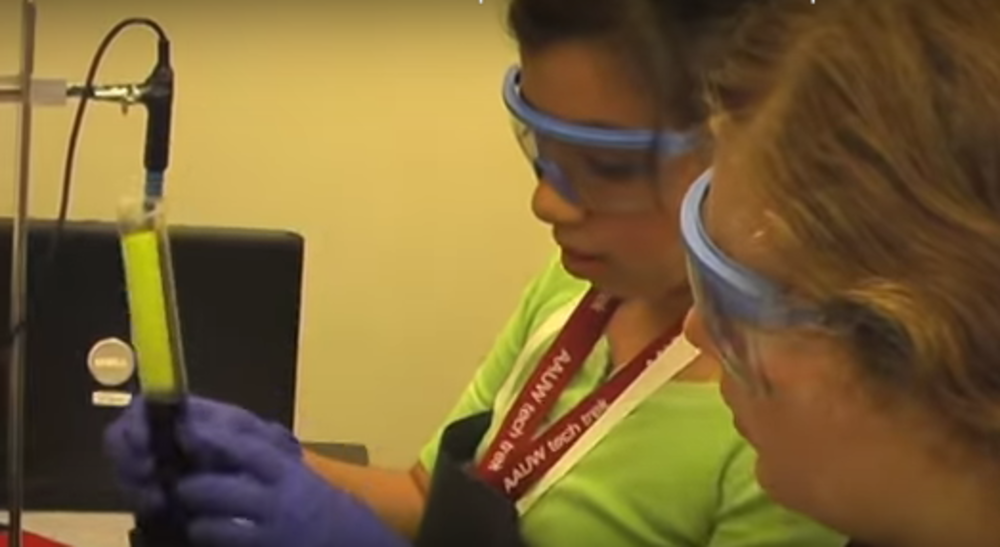
AAUW Tech Trek (aauw.org/what-we-do/stem-education/tech-trek) Held at 21 college campuses, this weeklong STEM summer camp is for rising eighth graders. More than 12,000 girls have participated since its 1998 launch. In a recent survey, nearly three- quarters said it opened their eyes to new STEM college majors.
Black Girls Code (blackgirlscode.com) With 10 U.S. chapters and growing, this group hosts workshops and hackathons year-round for girls 7 and up. Past programs have taught girls how to build a Web page, tinker with robotics, and design an app that could help teens in abusive relationships.
Digital Media Academy’s Made by Girls (digitalmediaacademy.org/made-by-girls) This group offers both co-ed and girls-only summer tech camps (Made by Girls) for students 6 and up. During the school year, students can also sign up for online courses like Fundamentals of Computer Science.
Girls Who Code (girlswhocode.com) Since its launch in 2012, Girls Who Code has reached more than 10,000 girls in 42 states. Girls in grades 6 through 12 can join one of its 400 afterschool clubs, while high schoolers can apply for its seven-week summer intensive. Tech companies like Facebook and Twitter have pledged support to alumni.
Source:
http://www.workingmother.com/
 Posted By: How May I Help You NC
Tuesday, May 10th 2016 at 11:32AM
You can also
click
here to view all posts by this author...